Blogging That Works - Part 3: Growing an Audience Without Spam
Distribution that respects readers: search basics, repurposing with intent, owning your audience with RSS and email, and measuring what actually matters.
 Dragos2 min read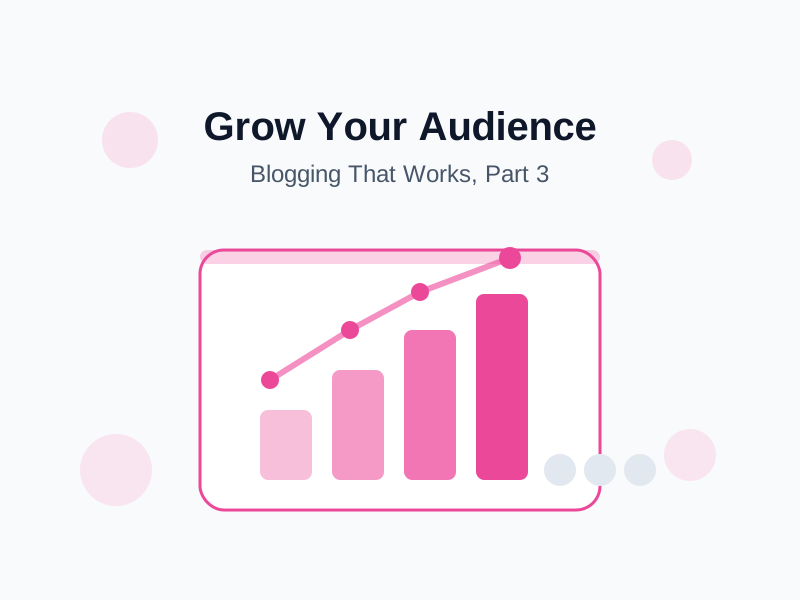
Blogging That Works
Part 3 of 3
The first two parts made publishing repeatable. This one is about the uncomfortable truth that follows: a blog nobody reads is a diary. Growth is not a growth-hack problem; it is a distribution problem you can solve with the same discipline you applied to writing.
Be Findable First
Most technical posts earn their audience through search. The basics are boring and they work:
- One clear topic per page, stated in the title.
- Headings that match how people phrase the question.
- Internal links between related posts, so readers — and crawlers — find the rest.
- Fast pages, because search engines and readers both punish slow ones.
You do not need advanced SEO tooling to do this. You need pages that answer one question well and link to the next one.
Repurpose With Intent
Every published post contains smaller pieces: a snippet, a diagram, a checklist, a strong paragraph. Extract them and publish where the audience already is — a developer community, a newsletter, a video description. The rule is to bring value to the platform, not a link with no context.
One post can responsibly become:
- A short thread or note with the key insight.
- A code snippet with a one-line explanation.
- A checklist people can save.
- An answer to a question someone already asked in a forum.
Own the Channel
Platforms change their rules. Two channels you control are worth more than a follower count:
RSS is the original subscription feed and still has a loyal audience. Make the feed discoverable and full-text if you can.
Email is the only channel that reaches people who opted in without depending on an algorithm. A plain newsletter with the latest posts and one useful idea per send is enough.
Put both links where readers finish an article, not buried in the footer.
Participate Instead of Broadcast
The most effective distribution is not posting links. It is being useful in places where your readers ask questions:
- Answer questions in your niche honestly, with no link if the answer does not need one.
- When a post genuinely answers a recurring question, link it once, with context.
- Show up consistently for months. Drive-by promotion is obvious.
Measure What Changes Behavior
Vanity metrics feel good and change nothing. Track the few numbers that lead to a decision:
| Metric | Decision it informs |
|---|---|
| Search impressions | Which topics to expand |
| Click-through rate | Whether titles and descriptions work |
| Returning visitors | Whether the blog has a reason to return |
| Email subscribers | Whether distribution is compounding |
If a number cannot change what you do next, it is decoration.
A Routine You Can Keep
A thirty-minute weekly routine covers most of it:
- Check which posts gained search impressions; add internal links to them.
- Answer one question in a community.
- Send or schedule the next newsletter.
- Update one older post that still gets traffic.
Conclusion
Growth comes from being findable, useful, and consistent — not from volume. Publish on a cadence, give each post a next step, and let the channels you own compound. That closes this series; the topic map, the workflow, and the distribution routine are the whole machine.